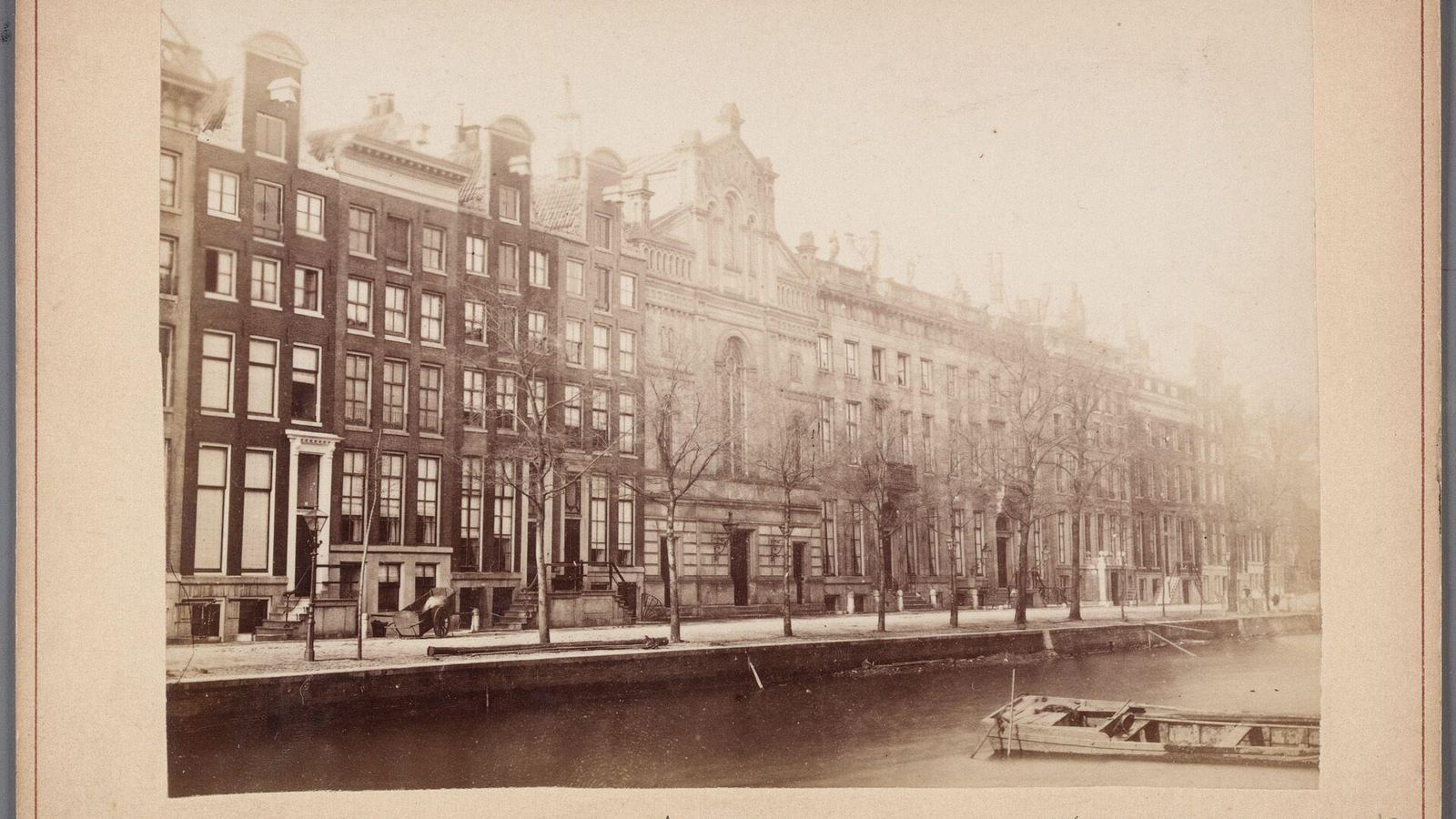
A Dortsman canal house, Rembrandt's pupil, and the regent family who made it their home
Keizersgracht 672 was built at the height of Amsterdam's Golden Age, when the city's merchants were extending the canal ring outwards to build bigger, grander houses with gardens behind them.
Its interior has remained largely intact over the centuries. Combined with the garden and coach house behind it, it gives a rare picture of how a wealthy Amsterdam family lived.
Willem van Loon is among the founders of the Dutch East India Company (VOC). His descendants become one of Amsterdam's regent families.
The architect Adriaen Dortsman designs the house at Keizersgracht 672 on the newly extended canal ring. Its first resident is the painter Ferdinand Bol, a former pupil of Rembrandt.
The house passes through the hands of wealthy Amsterdam families, who modernise the interiors with stucco, panelling and new decoration.
Hendrik Maurits van Loon buys the house as a wedding gift for his son Willem Hendrik and Thora Egidius, daughter of a Norwegian consul.
Thora van Loon becomes a dame du palais to Queen Wilhelmina. Her weekly receptions in the Blue Drawing Room make the house a centre of Amsterdam society.
The Van Loons' years in the house come to an end, after six decades on the Keizersgracht.
The house opens to the public as Museum Van Loon, with the family's portraits and collections in its period rooms.
Amsterdam's 17th-century canal ring, including the Keizersgracht, is inscribed on UNESCO's World Heritage List.
The museum shows the house alongside its formal garden and coach house, with temporary exhibitions that bring contemporary art into the historic rooms.
The Van Loons belonged to Amsterdam's ruling class for centuries: merchants, mayors and bankers. Willem van Loon was among the founders of the Dutch East India Company in 1602, and the family's portraits in the house span the generations that followed.
Thora Egidius (1865–1945), daughter of a Norwegian consul, married Willem Hendrik van Loon in 1884 and moved into the house as a bride. From 1897 she served Queen Wilhelmina as a dame du palais, and hosted a weekly reception in the Blue Drawing Room.
Dortsman gave the house a sober classical façade, topped by statues of Ceres, Mars, Minerva and Vulcan. Inside, later owners added stucco and panelling, and painted false doors keep the rooms perfectly symmetrical.
Behind the house, the formal garden is laid out in 17th-century style and closed by the classical façade of the coach house. The museum calls the combination of canal house, garden and coach house a unity seen nowhere else.
The Keizersgracht, the 'Emperor's Canal', is the middle of the three great canals of the 17th-century canal ring, built as Amsterdam grew rich on trade. Its houses were built for merchants and regents, with deep plots that left room for gardens and coach houses behind.
Most of those gardens have since been built over or divided. At Van Loon, the whole ensemble survives.
Museum Willet-Holthuysen on the Herengracht and the Museum of the Canals at Herengracht 386 are both a short walk away. Compare tickets →
The Rijksmuseum holds paintings by Bol, including his self-portrait. Rijksmuseum tickets →
Open daily, 10:00 to 17:00. €17.50, free with the Museumkaart and the I amsterdam City Card.